Meteor, Meteorite or Fireball? What a Bright Streak in the Sky Really Means
Meteorites updates | Explainer | 26 October 2026
A bright streak crosses the sky. Was it a meteor, a meteorite, a fireball or a shooting star? The clearest answer starts with one distinction: a meteor is the light phenomenon in the atmosphere; a meteorite is material that reaches the ground. Seeing one does not automatically mean that you can find the other.
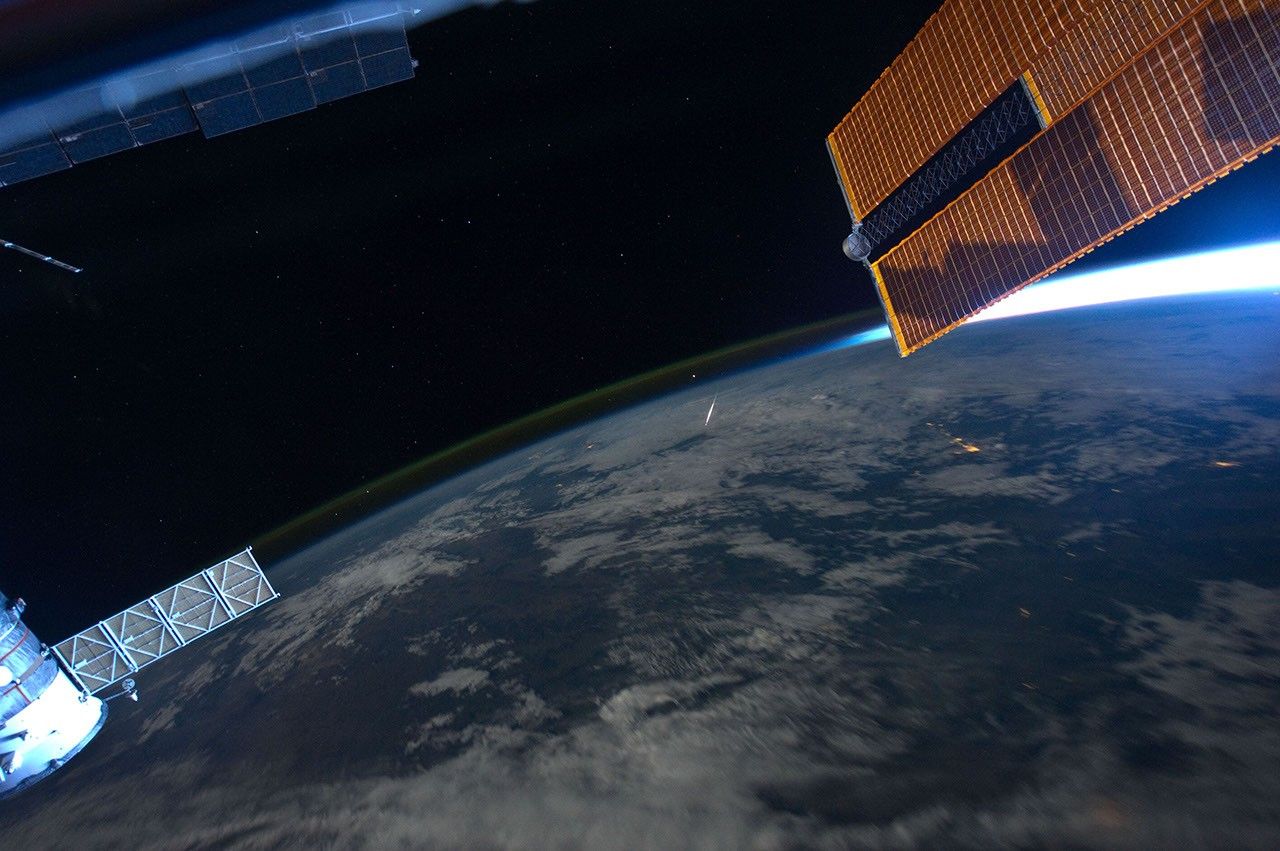
This guide answers the everyday question “meteor vs meteorite” using scientific sources, a real space photograph and a simple diagram. It does not identify any particular recent sighting from a photograph or short description.
Why fireballs attract attention
In a question-and-answer article published on 26 March 2026, the NASA Meteoroid Environment Office discussed public excitement about bright sightings in several U.S. states. The article is a useful reminder that a memorable sighting and a confirmed meteorite recovery are different kinds of evidence. It is a March 2026 source, not an announcement of a new event today.
Meteoroid, meteor and meteorite: the three names
A meteoroid is a small natural solid object in space. It may be a fragment from an asteroid or a particle released by a comet. When it enters an atmosphere at high speed, the luminous event is a meteor. “Shooting star” is a familiar nickname, but the event does not involve a star falling toward Earth.
A surviving piece that lands is a meteorite. These terms describe different things and stages, rather than three unrelated objects. The NASA meteors and meteorites overview provides an introductory guide to the vocabulary.
A labelled diagram: from space to the ground
● Meteoroid: natural solid material before atmospheric entry
☄ Meteor: the light phenomenon produced during entry
A particularly bright meteor is called a fireball.
● Meteorite: a surviving natural piece from space
Many meteors leave no recoverable meteorite.
What is a fireball, and why can it make a boom?
A fireball is an unusually bright meteor. The American Meteor Society commonly describes fireballs as brighter than approximately magnitude −4, comparable to bright Venus; technical conventions differ between observing systems. The everyday idea is exceptional brightness, not a separate type of rock. A bright fragmentation or explosive flare may be described as a bolide.
The NASA/JPL CNEOS explanation describes atmospheric compression, heating, material loss and fragmentation. Fast motion creates a shock wave. A loud sound is evidence of an atmospheric event, not a certificate that a particular stone on the ground came from it. Brightness alone also cannot tell you the rock's mineral composition.
Does every bright meteor leave a meteorite?
No. An object can lose material, break up and slow down during entry. Some events produce surviving fragments, while others do not yield a recovered specimen. Even a genuine fall can be difficult to locate and document. The meteorite and meteor-shower facts page explains why you should not expect meteorites after an ordinary meteor shower.
Most familiar showers are produced by small particles in debris streams associated with comets, although some showers have asteroid-related parent bodies. Their small or fragile particles generally do not provide recoverable meteorites. A meteor shower is therefore a skywatching opportunity, not a reliable collecting forecast.
What to record after a possible fireball sighting
If you are safely stopped, write down the date, local time and time zone, your observing location, the direction you faced, the beginning and end directions, approximate duration, colour, flashes and any delayed sound. Keep an original camera file if one exists. Describe uncertainty honestly: “about three seconds” is more useful than an invented precise time.
The American Meteor Society fireball FAQ explains useful observation details and how reports from different witnesses can help reconstruct a trajectory. Its fireball reporting form provides a structured way to report. Do not film while driving, pursue a light across roads, enter private land or travel into an unsafe area to search.
A simple example: observation is not recovery
Imagine that three neighbours see the same flash. One thinks it ended behind a nearby hill. Another thinks it disappeared over a distant town. Both are reporting a direction from their own viewpoint; neither has measured where a stone landed. Their accounts can still be useful when combined with timing and camera evidence. A newly found dark rock needs its own documented examination, rather than an assumed connection to the flash.
Quick answers
Is a shooting star a meteorite? The moving streak is a meteor. “Meteorite” describes a surviving piece on the ground.
Does a green flash prove a rare meteorite? No. A colour impression or camera colour is not a laboratory identification.
Can a sky photograph identify a rock I found? It can document the luminous event. Connecting a specimen to that event requires additional evidence.
Continue learning
- Module 1: Meteorite terminology and foundations
- Module 3: Meteoroids and atmospheric entry
- Module 6: Recovery and documentation
- Complete course contents: 31 modules and 186 lessons
Source review: 26 October 2026. This article is an educational explainer. It does not announce a newly confirmed meteorite fall.
Comments
Post a Comment