Meteorite Science Module 1: Introduction, Origins, History and Famous Falls
Complete course index · Level 1 Foundation · Module 1 · Lessons 1.1–1.6
This introductory module explains what meteorite science studies, how the main terms differ, how evidence established the field, and why documented samples matter. It includes six written lessons, safe learning activities and review answers. See the complete course index for the latest publication status of later modules.
Module learning goals
- Use scientific terminology correctly.
- Separate observations, interpretations and unsupported claims.
- Explain the historical and research value of documented meteorites.
- Prepare a small source-based study without damaging a specimen.
Lesson navigation
- 1.1 Definition, history and scope of meteoritics
- 1.2 Meteoroids, meteors, meteorites and micrometeorites
- 1.3 Historical development of meteorite science
- 1.4 Importance of meteorites in planetary research
- 1.5 Famous meteorite falls and discoveries
- 1.6 Careers and research opportunities in meteoritics
Work in sequence. Each lesson includes its own practice and review. No physical meteorite is required.
1.1 Definition, history and scope of meteoritics
Learning objectives: Define meteoritics, describe the questions it investigates, and separate an observation from an identification claim.
What the subject studies
Meteoritics is the scientific study of meteorites and related extraterrestrial material. “Extraterrestrial” means originating beyond Earth. The subject connects geology, chemistry, physics and astronomy. A geologist may describe the minerals and textures of a specimen; a chemist may measure its elements; an astronomer may investigate the path of the object before it entered the atmosphere. These different approaches help build a history of the same material.
A meteorite is evidence with a history, rather than simply an unusual stone. Scientists ask where its material formed, what happened on its parent body, how it travelled through space, and how it changed after reaching Earth. A parent body is the larger object from which material came. Most meteorites are linked to asteroids; some originated on the Moon or Mars. Connections to a particular source require several kinds of evidence, as explained by ASU’s introduction to meteorite origins.
Three different scientific tasks
Description records observable features: colour, dimensions, mass, surface condition and visible grains. Identification asks what the material is and whether an extraterrestrial origin is supported. Classification places confirmed material within a scientific system using appropriate mineralogical, chemical and other evidence. These tasks overlap, but one does not automatically complete the others.
For example, “the specimen contains shiny grains” is an observation. “Those grains are iron-nickel metal” is an interpretation that needs testing. “Therefore this is a meteorite from Mars” is a much larger claim that the observation does not establish. Keeping these statements separate makes a report useful even when the final answer is uncertain.
Begin with a record
Give a teaching specimen a temporary identifier, such as Teaching Sample A. Record whether its identity is known, who supplied its information and what you personally observed. Use a ruler in photographs and keep original image files. If working from a museum photograph, record the museum page and state that your observations come from an image. A photograph cannot provide a measured density or a verified chemical composition.
Many Earth rocks and manufactured materials resemble meteorites. ASU’s identification guidance explains that online screening cannot conclusively identify a specimen. For this introductory module, use photographs or already documented material. Avoid cutting, acid testing or applying hand magnets to an unknown specimen: preserving evidence is part of scientific work.
Practice and review
Activity: Write three sentences about a published specimen photograph: one direct observation, one possible explanation, and one question that would require laboratory evidence. Label each sentence.
Question: Does an unusual appearance establish extraterrestrial origin? Answer: No. It may justify further investigation, but identification needs evidence that also considers Earth rocks and manufactured materials.
Key terms: Meteoritics—study of meteorites; specimen—material being examined; provenance—documented origin and history; classification—placement in a scientific system.
Lesson summary: Meteoritics reconstructs histories through evidence. Good work begins with clear descriptions and an honest statement of what is still unknown.
1.2 Meteoroids, meteors, meteorites and micrometeorites
Learning objectives: Use the terms meteoroid, meteor, meteorite and micrometeorite correctly, and distinguish a witnessed fall from a later find.
One journey, different kinds of description
A meteoroid is a small natural solid body moving in space. A meteor is the visible light phenomenon produced during atmospheric entry. A meteorite is surviving extraterrestrial solid material that reaches the surface. The first and third terms describe material; the second describes an event that can be observed. A “shooting star” is a popular name for a meteor and does not mean that a star is falling. See NASA’s introductory explanation.
SPACE: METEOROID
Small natural solid body
ATMOSPHERE: METEOR
Visible light during entry
GROUND: METEORITE
Surviving solid material
Survival is not automatic
Atmospheric entry can remove material and break an incoming body into fragments. Ablation means loss of surface material during entry, including melting and vaporization. A surviving stone may develop a thin fusion crust as surface melt cools. The bright meteor is not a photograph of the stone’s interior, and a bright event alone does not prove that recoverable stones reached the ground. Module 3 will examine these processes in detail.
A meteor shower occurs when Earth encounters a stream of particles, commonly debris released by a comet. A shower is an increase in visible meteors, not a promise of meteorites on the ground. Keep the observation “many streaks of light were seen” separate from the claim “stones were recovered.” NASA’s meteor facts discusses this distinction.
The smallest survivors
Micrometeorites are tiny extraterrestrial particles that survive atmospheric entry and can be collected at Earth’s surface. Some melt during entry; others retain unmelted material. A round grain in a gutter is not automatically cosmic: Earth materials and industrial particles can also be spherical. Identification uses microscopic and chemical evidence together with collection records. The Natural History Museum’s cosmic-dust introduction explains why careful collection matters.
Falls and finds
A fall is associated with an observed fall event and subsequent recovery. A find is recognized without an observed fall associated with its recovery. A find date is therefore not necessarily the arrival date. An old weathered find can still be scientifically important; a fresh fall can preserve information that changes after exposure to Earth’s environment.
Practice and review
Activity: Label these descriptions: (A) a small natural body orbiting the Sun, (B) a streak of light recorded by a camera, (C) an identified surviving stone collected after that event, and (D) an identified meteorite discovered without a witnessed arrival.
Answers: A—meteoroid; B—meteor; C—meteorite from a fall; D—meteorite find. The label “meteorite” in C and D assumes identification has been established.
Key terms: Ablation—loss of material during entry; fusion crust—cooled surface melt; micrometeorite—small extraterrestrial survivor; fall and find—different recovery histories.
Lesson summary: Describe the object, light event and recovery history precisely. Correct names prevent unsupported conclusions.
Previous lesson · Next lesson · Module navigation · Course index
1.3 Historical development of meteorite science
Learning objectives: Explain how meteorite science developed through investigation, identify the importance of Chladni and Biot, and connect historical methods with modern evidence checking.
From reports to testable explanations
People reported stones falling from the sky long before modern laboratories existed. A report raised a question, but explaining its cause required reliable observations. Scientists had to consider whether witnesses described the same event, whether recovered stones were linked to it, and whether ordinary local geology could explain the material. Scientific progress depended on connecting those lines of evidence.
In 1794, the German scientist Ernst Chladni published an argument supporting an extraterrestrial origin for falling stones and unusual iron masses. This did not end the debate immediately. It offered an explanation that could be compared with later falls, recovered specimens and witness accounts. The history is described by the Natural History Museum Vienna.
The L’Aigle investigation
On 26 April 1803, stones fell near L’Aigle in France. Jean-Baptiste Biot investigated the event for the French scientific institution. His work connected witness accounts with the distribution and character of the recovered stones. The investigation helped establish meteorites as legitimate scientific objects. The Muséum national d’Histoire naturelle’s account of L’Aigle explains the role of the field evidence.
The lesson is broader than remembering a date. A convincing explanation should account for the observations together. A single striking story may be mistaken; several records may agree because they copied one another. Investigators must consider independence, timing, location and the actual specimens. Agreement becomes stronger evidence when the sources are independently documented.
What changed with laboratories?
Field observations established that material could arrive from beyond Earth. Later laboratory methods allowed more detailed questions: which minerals are present, how are grains arranged, and which chemical or isotopic measurements distinguish groups? Petrography describes rocks and their textures, often with a microscope. Geochemistry examines chemical composition and chemical processes in geological material. Modern investigations combine these approaches rather than relying only on appearance.
More instruments do not remove the need for clear reasoning. A printed analytical result still needs a specimen identifier, a description of the method and an explanation of the result’s limits. A historical witness statement and a modern laboratory report are different sources, but both must be traceable to the evidence they describe.
Build an evidence timeline
Activity: Draw three columns headed date, evidence and inference. Add Chladni’s 1794 publication and the 1803 L’Aigle investigation. In the evidence column, distinguish a published argument from field observations. In the inference column, explain what each could support. Then add a modern example of mineral analysis without inventing a measurement.
Question: Why was collecting stones and checking local observations more useful than simply repeating that stones had fallen? Answer: Physical material and documented context allow other people to examine the explanation and consider alternatives.
Key terms: Hypothesis—a proposed explanation; evidence—observations or measurements relevant to a question; independent source—a record not merely copied from another; petrography—description of rock minerals and textures.
Lesson summary: Meteorite science developed through arguments tested against documented material. That same standard applies to identification claims today.
Previous lesson · Next lesson · Module navigation · Course index
1.4 Importance of meteorites in planetary research
Learning objectives: Describe four questions meteorites help investigate, explain why context matters, and distinguish scientific value from appearance or price.
Samples that preserve different histories
Earth’s rocks are changed by geological processes. Meteorites provide additional samples from other bodies and from early Solar System material. They are valuable because different components can preserve different events. A grain may record its formation; a surrounding rock may record later heating; a surface may record exposure and weathering. Asking “How old is this meteorite?” therefore requires a second question: “Which event are we dating?”
ASU’s explanation of meteorite importance identifies several major research themes. Some meteorites contain presolar grains, meaning grains formed before our Solar System. Elemental and isotopic measurements help investigate the ages and relationships of early materials. Meteorites also preserve evidence of impacts and contain organic compounds relevant to chemical evolution.
Four questions and the evidence they need
- When did a material form? Researchers can measure suitable isotope systems. An isotope is a form of an element with a particular number of neutrons. Interpreting a date requires understanding which event the chosen system records.
- What happened inside a parent body? Minerals, textures and chemical relationships can reveal heating, melting or interaction with water. One feature should be interpreted together with the rest of the rock.
- Where might the rock come from? Comparison with known planetary samples and spacecraft measurements can support a source relationship. Appearance alone does not establish a lunar or Martian origin.
- What chemical ingredients existed beyond Earth? Analyses of organic compounds investigate nonliving chemistry as well as questions relevant to life. Organic molecules contain carbon; finding them does not by itself demonstrate organisms.
The comparison of lunar meteorites with returned lunar samples, and of gases in some Martian meteorites with measurements of the Martian atmosphere, illustrates how independent observations can support source interpretations. ASU’s meteorite origins page introduces these comparisons. Later modules explain their analytical detail.
A tiny sample can still answer an important question
Scientific value depends on the research question, the material preserved and the quality of the record. A large attractive specimen with an uncertain history may answer fewer questions than a small well-documented sample. Recovery location, handling history and links between subsamples can be essential. Once a sample is cut or chemically treated, some future measurements may no longer be possible.
Magnetic records are a concrete example. A strong hand magnet can overwrite ancient magnetization, removing information about past magnetic fields. This is documented in Vervelidou and colleagues’ 2023 study. For beginner study, use reference images and published measurements; do not apply magnets to valuable or unknown material.
Practice and review
Activity: Choose one of the four questions above. Write the observation or measurement you would need, one possible source of uncertainty, and one action that might damage the evidence. You do not need to perform the measurement.
Example answer: To investigate a rock’s magnetic history, I would need specialist magnetic measurements and a handling record. Prior exposure to magnets is a source of uncertainty. Touching it with a strong magnet could alter the evidence.
Question: Does a high sale price establish high scientific value? Answer: No. Price is a commercial outcome. Scientific usefulness depends on evidence and the questions a specimen can answer.
Key terms: Isotope—form of an element with a different neutron count; presolar—older than the Solar System; organic compound—carbon-containing chemical compound; contamination—introduced material or alteration that affects interpretation.
Lesson summary: Meteorites connect laboratory measurements with planetary history. Preserving the specimen and its records protects the questions future researchers can ask.
Previous lesson · Next lesson · Module navigation · Course index
1.5 Famous meteorite falls and discoveries
Learning objectives: Compare documented falls, identify the evidence that made each useful, and prepare a source-based case study without copying unsupported claims.
L’Aigle: connecting observations and specimens
The L’Aigle fall in France on 26 April 1803 is important for the history of evidence. Biot’s investigation linked eyewitness accounts, recovered stones and their distribution. The case helped establish extraterrestrial falls as a scientific subject. For this example, the key question is not “How expensive is the stone?” but “How do the records connect the stone with the reported event?” Consult the French national natural history museum’s L’Aigle account.
Allende: early materials available for laboratory study
Allende fell in Chihuahua, Mexico, on 8 February 1969. The Smithsonian Institution Archives record describes the recovery and the opportunity to study the material using equipment prepared for lunar-sample research. NASA’s meteorite teaching sample resource identifies Allende as a carbonaceous chondrite.
Carbonaceous chondrite is a scientific category of stony meteorite, not a statement that every fragment contains the same amount of carbon or has the same texture. A short catalogue label is an entry point for research. It does not replace detailed measurements or a published classification description. In a case study, copy the official name carefully and identify the source of the classification.
Murchison: organic chemistry and contamination control
Murchison fell in Victoria, Australia, on 28 September 1969. Its study provided evidence for extraterrestrial amino acids and other organic compounds. ASU’s Murchison account links the fall with the early research and published references. Amino acids are a family of organic molecules; organisms use some amino acids to build proteins, but such molecules can also form without life.
This distinction changes how we read a headline. “Organic molecules were found” is a chemical result. “Life was found” is a different and much stronger claim. Investigators must also consider whether a chemical was present in the extraterrestrial material or introduced by handling and the Earth environment. Keep those questions visible in your report.
Almahata Sitta: linking space observations with recovered material
The small asteroid 2008 TC3 was observed before entering Earth’s atmosphere over Sudan in October 2008. Meteorites recovered from the event are named Almahata Sitta. The ASU origins account describes the tracked object and the diversity of recovered rock types. This case illustrates why a sky observation, an estimated path and a recovered specimen should be connected by documented evidence.
Make a comparison record
Activity: Choose two cases above and record: official name, event date, country, whether the case concerns a fall or find, the source consulted, the scientific question, and the evidence used. Add “not supplied by this source” where a detail is missing. Do not fill gaps from an unverified sales listing.
Question: Why might two famous meteorites be important for different reasons? Answer: One can be important for the history of establishing falls, another for organic chemistry, and another for linking a tracked object to recovered material. “Famous” does not identify a single scientific property.
Key terms: Case study—focused investigation of a documented example; carbonaceous chondrite—a recognized meteorite category; amino acid—an organic molecule in a chemical family; source record—traceable information supporting a claim.
Lesson summary: A useful meteorite case study connects a named specimen, documented event and specific scientific evidence. It separates what the source reports from what remains uncertain.
Previous lesson · Next lesson · Module navigation · Course index
1.6 Careers and research opportunities in meteoritics
Learning objectives: Recognize different roles in meteoritics, plan an introductory learning project, and understand the limits of a self-study course.
A field with several kinds of work
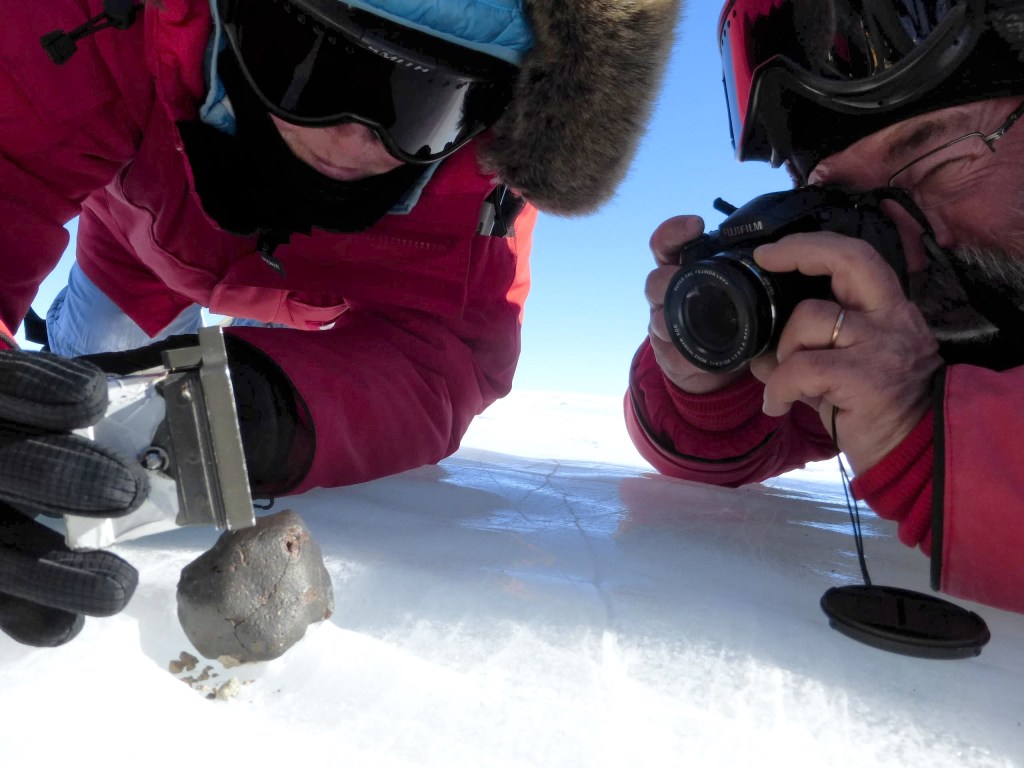
Meteorite research brings together people with different skills. Researchers formulate questions and interpret evidence. Laboratory specialists prepare suitable samples, operate instruments and assess measurement quality. Collection staff maintain labels, inventories, storage records and access for future study. Educators help learners understand the evidence. Field teams recover and document material in its surroundings. These roles may overlap, and the training required depends on the work.
Build a foundation before choosing a specialty
Useful starting subjects include geology, mineralogy, chemistry, mathematics, physics and scientific writing. Data handling and statistics become valuable when comparing measurements. A researcher studying isotopes needs different specialist training from a curator documenting a collection, but both need careful records and responsible interpretation. Reading an instrument name is not the same as being trained to operate that instrument.
For a beginner, progress can begin with existing information. Compare two published specimen descriptions. Make a glossary in your own words. Explain a figure and identify its scale. Write a short report that separates the author’s measurements from your interpretation. These activities build scientific habits without buying a specimen or attempting an unsupervised laboratory procedure.
A practical starter project
- Choose a manageable question. For example: “What different kinds of evidence made L’Aigle and Murchison scientifically important?”
- Use named sources. Begin with the museum and university resources linked in Lesson 1.5. Record the page title, institution, URL and access date.
- Make an evidence table. Separate the reported observation, the scientific interpretation and any information the source does not provide.
- Write a one-page explanation. Define unfamiliar terms and include a conclusion that answers the question.
- Review your claims. Check every date, classification and quoted measurement against its source. Revise any sentence that sounds more certain than the evidence.
You may also explore ASU’s student-opportunities information to see examples of academic research and student participation. Eligibility, funding and availability can change; use the current institutional pages when considering a specific opportunity. This lesson makes no promise of admission, employment or funding.
Communicating responsibly
Describe the training you have actually completed. Introductory self-study does not grant authority to assign accepted meteorite names, certify a laboratory or issue a definitive classification. When sharing a report, state whether you used a physical specimen, a photograph or published data. If you need expert help, check the institution’s current submission guidance before sending any material.
Activity: Write a learning plan with one knowledge goal, one evidence-handling skill and one finished output. Example: “I will explain fall versus find, keep a source log and write a comparison of two documented meteorites.” Set a realistic review date rather than treating the whole expanded syllabus as a guaranteed short course.
Question: Can useful learning begin without an expensive specimen collection? Answer: Yes. Published photographs, catalogue descriptions and scientific datasets support many introductory exercises. Physical and analytical competence still requires appropriate supervised experience.
Key terms: Curator—person responsible for a collection; reproducibility—ability to check or repeat work using adequate records and methods; competency—demonstrated ability to perform a task; source log—a record of consulted information.
Lesson summary: Develop skills through small, documented projects. Scientific credibility grows from evidence, training and honest communication.
Module review
- Why is a meteor an event while a meteorite is material?
- Explain one difference between description, identification and classification.
- What kind of evidence made the L’Aigle investigation important?
- Why do organic compounds in a meteorite not establish life?
- How could an apparently simple identification test damage research evidence?
- What should you record when working from a photograph rather than a physical specimen?
Answer explanations
- A meteor is the visible light phenomenon during entry; a meteorite is solid extraterrestrial material that survives to the surface.
- Description records features. Identification evaluates what material is present and its origin. Classification uses appropriate evidence to place confirmed material in a scientific system.
- The investigation connected witness reports with recovered stones and their distribution; it could be checked against material evidence.
- Organic compounds can form without organisms. A chemical observation and a biological interpretation are different claims.
- A strong hand magnet can overwrite natural magnetic records. Destructive or contaminating tests can also remove information.
- Record the source, identifier if provided, scale, visible features and the limits of an image. Do not claim measurements or laboratory results you did not obtain.
After Module 1
Continue with Module 2: Formation of the Solar System. The course index lists all published modules and identifies material still in preparation.
References and image use: Scientific sources are linked beside the relevant explanations. Links were checked on 26 October 2026. The original diagram is offered under Creative Commons Attribution 4.0. The NASA photograph retains its own stated media-use conditions and credit.

Comments
Post a Comment